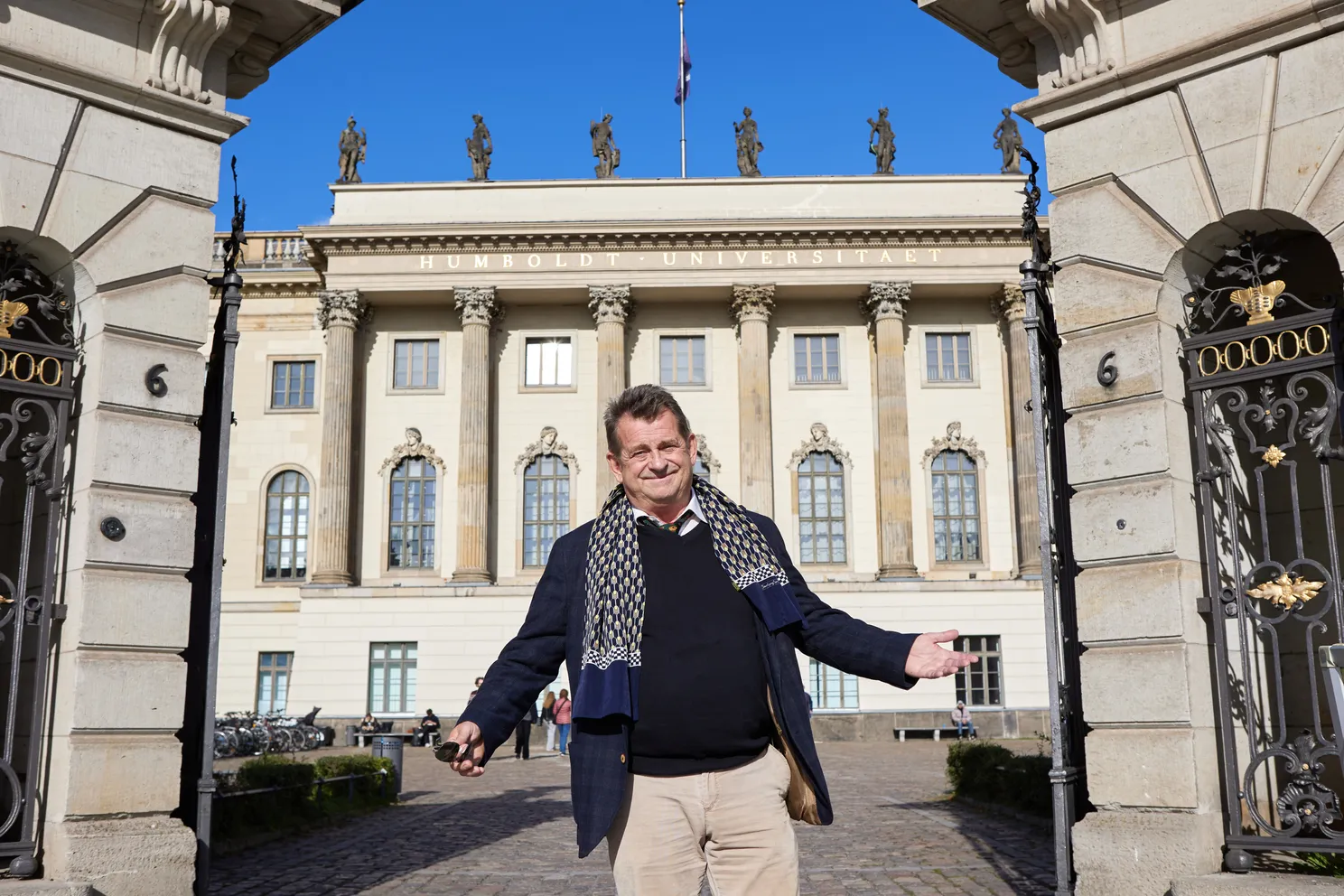
Berlin City of Science and Nobel Laureates
A fascinating journey of discovery with science journalist Eckart Granitza - from the great researchers of the 19th century to today’s laboratories of the future.
Berlin: A Capital of Science
Berlin has long been a centre of scientific discovery and technological innovation. More than 40 Nobel laureates have conducted research, taught or worked here, including Max Planck, Albert Einstein, Fritz Haber and Gerhard Ertl.
Science journalist Eckart Granitza takes you to landmark locations where Berlin’s scientific past and present come to life. Through captivating stories and surprising connections, he reveals how researchers in Berlin helped shape the theory of relativity, quantum theory, modern chemistry and medicine - and why Berlin remains one of Europe’s leading centres of scientific research.
Welcome at Barachel Café
Over coffee or tea at Barachel Café on Friedrichstraße, you will meet your host and receive an introduction to the themes of the tour.
First Stop: Humboldt University of Berlin
Founded in 1810, Humboldt University revolutionised higher education through its pioneering educational model, which brought research and teaching together in a systematic way, moving beyond the traditional, teaching-focused university.
Berlin became a powerhouse of scientific research, and its university model went on to inspire institutions around the world. Figures such as Hegel, the Brothers Grimm, Max Planck and Albert Einstein are associated with the university’s history.
Johns Hopkins University in the United States drew inspiration from the Berlin model, while Harvard and Yale later combined elements of it with the Anglo-American college tradition.
Berlin-Brandenburg Academy of Sciences and Humanities
At Gendarmenmarkt, you will discover an institution with a remarkable history. Founded in 1700 under the guidance of Gottfried Wilhelm Leibniz, the academy brought the natural sciences and humanities together under one roof, distinguishing itself from its counterparts in London and Paris.
As the Prussian Academy of Sciences, it gained international renown, helped shape the global scientific landscape and became a model for later academies. Today, it continues to foster interdisciplinary exchange and advance Berlin’s scientific community.
Max Planck Society
Nearby is the Berlin office of the Max Planck Society, one of Germany’s leading research organisations. Its 85 institutes conduct internationally acclaimed fundamental research across the natural sciences, life sciences, humanities and social sciences.
A key to its success is the scientific freedom granted to outstanding researchers, who enjoy considerable independence in choosing their research topics and building their teams.
Charité - Universitätsmedizin Berlin
The Charité is one of Europe’s most important centres for medical research. Pioneers such as Rudolf Virchow and Robert Koch are central to its distinguished history.
Today, the Charité combines fundamental biomedical research with clinical medicine. Around 5,800 researchers work on more than 1,000 projects, advancing innovative approaches that will help shape the future of healthcare and medical treatment.
Museum of Natural History
The tour concludes at the Museum of Natural History, an internationally renowned research institution specialising in evolution and biodiversity. Its collection of more than 30 million specimens provides an exceptional foundation for investigating the evolution of life, changes in biodiversity and the history of our planet.
Eckart Granitza explores how scientific discoveries emerge from observation - and why historical collections remain indispensable to the research of tomorrow.
A Culinary Finale at Restaurant Esszimmer
The tour concludes with lunch at Restaurant Esszimmer, featuring modern German cuisine inspired by seasonal and regional ingredients. In a relaxed atmosphere, there is time to get to know your host and fellow guests while exchanging ideas about science, innovation and Berlin’s future.
Duration
3:50 hours
Dates and Booking
Next dates
January 2027